

Extravagant Compassion
God yearns for all persons to come to know their own belovedness and know it with every cell of their being | An Excerpt from Compassion in Practice


Years ago, a college student boarded a bus heading home for spring break. Because the bus was nearly full, he sat down next to a man staring out the window. The man was middle-aged and dressed in denim. He bore the hard-edged look of someone haunted by a life he would rather soon forget. The man was not up for small talk. He was lost in himself. He simply gazed at the passing corn fields and farmhouses as the bus rolled along the two-lane coun try roads.
A couple of hours into the ride, the hard-edged man grew agitated. Fingering his work cap, he stared down at the floor, only casting quick glances out the window as if not wanting to look too closely. The college student asked if the man was okay. The man regarded him, glanced once more out the window, then desperately shared his story.
“Twenty years ago,” the man confessed, “I killed a man. I was boozin’ it up, got inside a car, never saw the guy just crossing the street. I’ve been in prison all these years just thinkin’ about it. I felt so ashamed. I sent a letter to my folks—told ’em that I knew I wasn’t any good and that I was in prison, but I didn’t tell ’em where. As far as they were concerned, they should count me dead. I haven’t seen or heard from ’em ever since.
“I got paroled a couple days ago. Didn’t have no place to go really. So I wrote my folks. I told ’em I was getting out. And I know I’ve brought nothing but shame to them and our family, but I told ’em if they would have me, I would love to come home. I’d get it if they didn’t want me back. So I’d make it easy on ’em. In our front yard is this big, old oak tree. The bus drives right by our house on the way into town. If they would have me, all they got to do is tie a yellow ribbon around that tree. If it’s there, I’ll get off the bus at town and come home. If it’s not there, I’ll just stay on the bus. And they don’t ever have to lay eyes on me again.
“The thing is, now that we’re getting close, I’m not sure I can bear to look. I mean, I get it. But if that oak tree is bare, why, I don’t know what I’ll do.”
The man started to look out the window then stopped him self, staring at the floor instead. Then an idea came to him.
“Say,” he asked the student, “would you mind looking for me? I’ll just look the other way, and you can let me know.”
The student agreed, and the man swapped seats with him. The student scouted while the ex-con fingered his cap and stared at the floor. House after house passed by. Tree after tree was barren of ribbons. The bus drove closer to the town.
Then, with a shout, the student saw it. “Oh my God, you have to see this!”
The former convict dared to look as the bus was passing his childhood home. A giant oak tree stood sentry in the yard. The tree did not bear a single yellow ribbon; it boasted hundreds of them. Flapping in the breeze from every branch of the tree, yellow ribbons proclaimed to the world, “Our boy is coming home. And we cannot wait to embrace him.”
This story was so inspiring and resonant that Tony Orlando and Dawn’s recorded song about it became a worldwide hit in the 1970s— thus prompting hundreds of homesteads to fly yellow ribbons for soldiers returning from Vietnam.10 Those ribbons serve as a parable of the God that Jesus knew. His God is extravagantly compassionate, with a love so wide it welcomes home every lost and broken wanderer of the world. In fact, compassion so thoroughly captures God’s essence that Jesus rewords the core commandment that formed the central pillar in the purity code of his day. With brilliant precision, he substitutes, “You shall be holy to me; for I the Lord am holy” (Lev. 20:26) with his own summative invitation, “Be compassionate just as your Father is compassionate” (Luke 6:36, CEB). At the very core of God’s identity, we find neither judgment, punishment, cold aloofness, nor unapproachable strictness; rather, God welcomes us into the embrace of God’s loving presence—a presence that is infinitely understanding about our shames and our pain and only too eager to adorn us in robes and rings of glory.
And yet, scandalously, Jesus goes further. We can know this God of extravagant compassion directly. Jesus’ own spiritual journey is grounded in an immediate experience of God at his baptism. God communicates directly to him: “You are my Son, my Beloved; with you I am well pleased” (Mark 1:11). And Jesus knows that this same God yearns for all persons to come to know their own belovedness and know it with every cell of their being—with all of their heart and soul and mind and strength. Jesus’ understanding of God is remarkable within a system where the religious elite have the power to make spiritual purity, cultic cleanliness, and righteousness before God dependent on paying Temple taxes, fulfill ing codes of holiness, and securing ecclesiastical pardon for ever-evolving offenses. Jesus proclaims that we are already held in God’s compassion ate embrace. We are already acceptable in God’s sight. God has already forgiven our sins, and the forgiveness has nothing to do with eating clean food, fulfilling holy days of obligation, or paying off those set out to exploit us with blood sacrifice. It has only to do with opening our eyes, waking up to that which is already and eternally true, and allowing the reality of God’s infinite love to settle deep within us. We can know in the core of our beings that a compassionate God holds us with care, and we can know it with such an inner authority that we can be free from the insidious power of any body—religious or otherwise—that seeks to coerce our acquiescence.
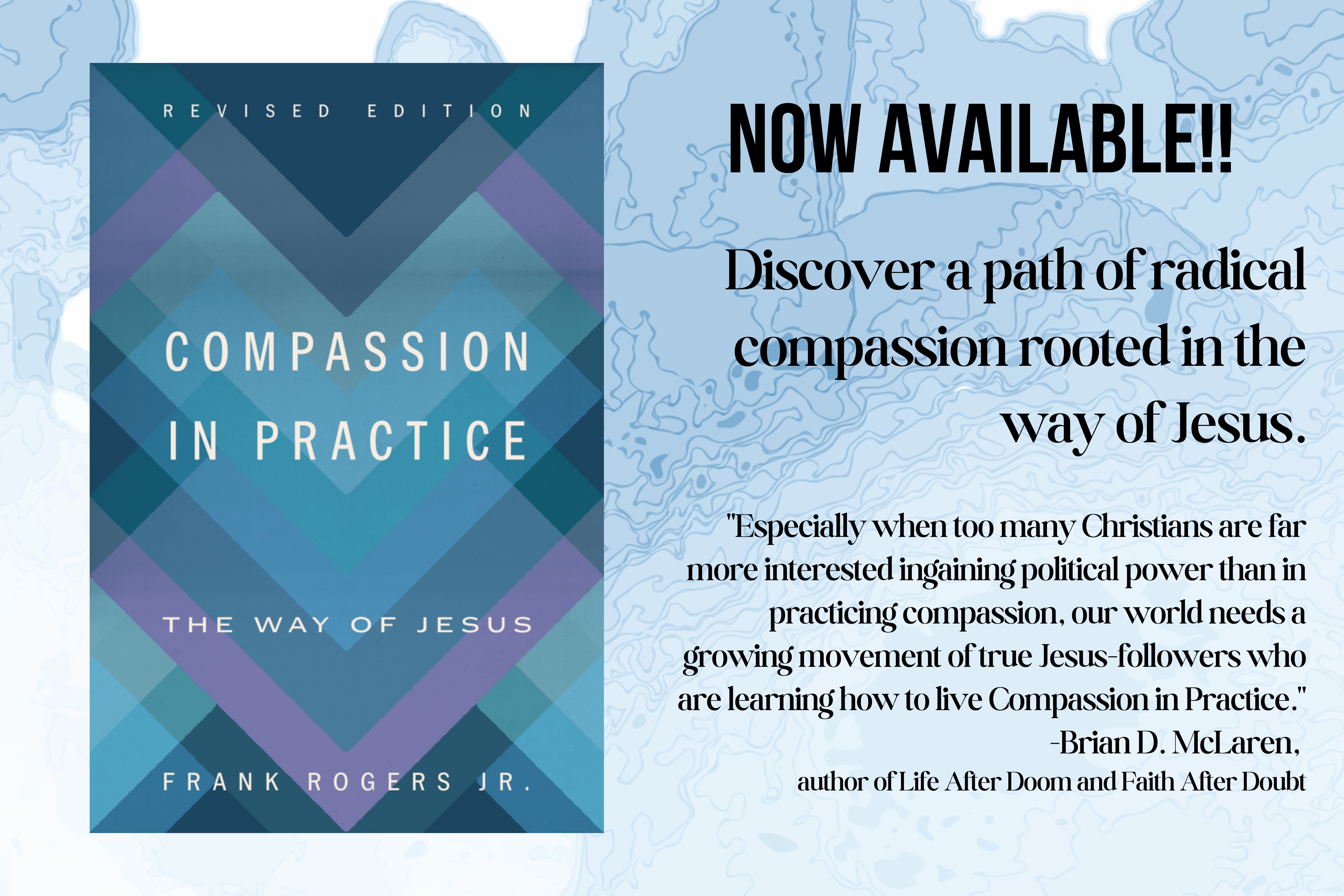
Discover a path of radical compassion rooted in the way of Jesus.
How do we practice love and compassion for ourselves and others in a world marred by conflict and violence in our families, communities, institutions—and even our own hearts? In Compassion in Practice: The Way of Jesus, internationally renowned compassion teacher Frank Rogers introduces the spiritual path of radical compassion Jesus walked and taught, grounded in God’s extravagant love for all people. This path transforms hardened hearts and brings healing and wholeness to even the most challenging situations.
In this inspiring and practical book, you’ll discover a series of practices to ground and restore you through self-compassion as you cultivate an ethic of radical care that extends not only to loved ones, neighbors, and strangers, but also to enemies, opponents, and oppressors. Illuminated with extraordinary real-life stories of restorative love in action, these practices will equip you to step heart-first into a challenging world, ready to engage in a new way that beats with the pulse of compassion.
This updated and revised edition provides specific practices for compassionate social activism, more interfaith conversation, and a “compassion compass” to help orient you as you travel the path of healing and restoration.
In Compassion in Practice, you will learn:
The six essential dimensions of authentic compassion
A compassion practice that softens hardened hearts and accesses our best self
Spiritual exercises to cultivate compassion for yourself and others
The critical difference between empathy and compassion
How to practice compassion with a difficult person or amid violence and injustice
Ten principles of empowered and just compassionate action

The Center for Engaged Compassion is a a 501c3 non-profit organization and practical education center that seeks to repair the world by applying the ancient wisdom of compassion and contemplative practices to the problems of today. The Center works in conjunction with a number of academic, institutional, business, and denominational organizations giving people enduring, effective skills to bring peace, reconciliation, and healing to the world.
The wisdom traditions of the world teach that this kind of compassion — a compassion that emerges from a truly engaged sensibility — is necessary for creating true peace, reconciliation, and healing within secular as well as religious contexts. The Center’s social transformation projects, academic programs, and research & development initiatives integrate the knowledge and formative practices of the world’s wisdom traditions with the most advanced contemporary understandings of the human arts and sciences.

Frank Rogers Jr., PhD, is the Muriel Bernice Roberts Professor of Spiritual Formation and Narrative Pedagogy at Claremont School of Theology. He’s a spiritual director, speaker, retreat leader, and the author of Cradled in the Arms of Compassion, Practicing Compassion, Compassion in Practice: The Way of Jesus, and The God of Shattered Glass: A Novel. He focuses on spirituality that is contemplative, creative, and socially liberative. He is the cofounder of the Center for Engaged Compassion and lives in Southern California with his wife, Dr. Alane Daugherty, with whom he shares three sons. www.centerforengagedcompassion.com.